The story centers on “Chronos Rulers,” those who fight the time-eating demons that appear when people wish they could turn back time. The Chronos Rulers fight a time-manipulation battle against these demons. – Wikipedia
Episode 1 Summary: Koyuki and her friends are about to graduate from high school. Koyuki wants to put on a musical performance at their graduation ceremony, but regrets that her brother won’t be able to attend. He passed away rescuing her from being hit by a car, and she still carries that regret with her. When other students begin muttering about a clock tower in town where one can make a wish a turn back time, Koyuki is greatly tempted by it. Unfortunately, conducting the ritual only attracts the attention of a “Horologue,” a demon who feeds on human beings’ time-related regrets. Luckily, she’s protected from harm by Kiri and Victo, individuals with some control over the speed that time progresses. They’re able to dispatch the horologue, but at the cost of some of Victo’s memories. Victo himself is the victim of a horologue; though he appears to be a young man, he’s slowly becoming younger and younger, losing time and memories of his past life in the process.
Impressions: Note: Contains a spoiler for the major revelation at the end of the first episode.
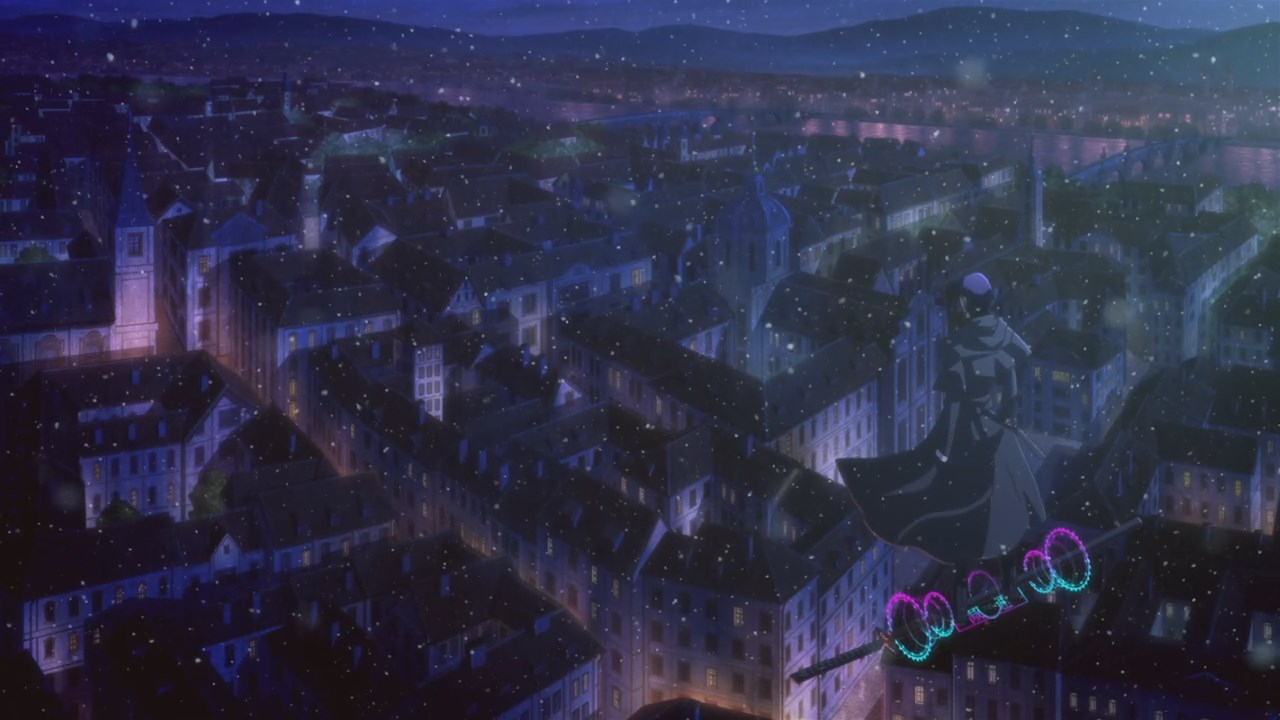
Kiri looks out over the city after his battle with a Horologue. Copyright 2017 (c) project No. 9
Chronos Ruler is kind of an oddity in my eyes. What starts as sort of a typical early-2000’s-style buddy cop urban fantasy series a-la Descendants of Darkness turns weird (weirder?) when we learn that the two main characters, who’d normally probably be assumed yaoi couple and primary draw of an otherwise straightforward TV anime, are actually father and son. Due to some weirdness related to the flow of time (basically the entire mechanic that makes up the plot), the youthful, twerpy protagonist is suddenly made to be a tragic figure and his “brother,” actually his son, is the one who gets to watch him slowly fade into nothingness. Fun times! It’s kind of a unique situation, a surprise for me as a viewer; for a medium that relies a lot on copying what came before, I think that’s something to be lauded. I just wish that the concept had been a part of a show less workmanlike and a bit more interesting in other ways.
As an action vehicle, this episode does some good things using what it has to work with. I thought that the opening scene was especially exciting and well-executed; Kiri chases a horologue through the streets of the city and there are lots of dynamic shots with some slow-motion pauses that ramp up the “cool” factor a bit. They also emphasize, without outright saying anything, the nature of the character’s time manipulation ability, which I thought was a nice touch. There’s also some surprisingly good CG integration in these scenes; the moving backgrounds and the horologue enemy are both accomplished using primarily CG animation, and the character animation goes between 2D and 3D in this and later scenes, depending on the complexity of the camera movement and distance from the camera. Obviously it’s noticeable since I noticed it, but I think it works well and isn’t so jarring as to become distracting. As compared to something like Hand Shakers, my low-bar for diarrhea dumping CG elements into an anime, Chronos Ruler is relatively judicious with its CG and the resulting product is very watchable.
A horologue is produced from Koyuki’s regrets. Copyright 2017 (c) project No. 9
The episode does have a glaring problem, however. Like many anime before, there is an overriding tonal conflict that takes away from the meat of the show. Overall I’d peg this as a relatively serious action/fantasy series with kind of a classic feel to it; there’s an opportunity for contextual humor with a sarcastic, cynical edge, but for the most part the story seems to lend itself to being straightforward and a little dark or melancholy. But several times throughout the episode, the character interactions devolve into something out of a manzai routine, with Kiri as the exhausted straight man and Victo as the goofball. These moments serve to heighten the tragedy of the characters’ situation when it’s revealed later, but in the midst of the exposition these moments are distracting and irritating. This episode deals with a regretful death, albeit in kind of a melodramatic way. There’s an overall sadness to it that isn’t well-served by this type of intrusive goofiness, and to be honest I’d rather be ham-handedly manipulated into feeling sad for the characters than jerked-around between feeling bad and feeling irritated over the immaturity of the production.
Time travel and time manipulation are two subjects that are rarely examined in a way that’s comprehensible, because due to the nature of time itself, messing around with it creates every manner of logical conundrum and paradox one could imagine. I doubt that this anime series, which seems to operate entirely under the guise of the “rule of cool” has the chops to really follow through on that front. And as a bishounen vehicle, well, I’m sure there are many fans who won’t worry about the father-son dynamic in the protagonists’ relationship (nor should they: people can like what they want), but for me that kind of removes all that would have attracted me from the “hot guys doing action stuff and being hot together” angle. Ultimately I’d expect this show to unfold in way that’s mildly entertaining but probably pretty forgettable.
Pros: The action elements in the first episode are pretty well done. There’s good integration of CG elements.
Cons: The comedy stuff sticks out like a sore thumb. The relationship between the protagonists could be weird/squicky for some.
In a world where Spirits and Humans coexist and can fall in love with each other, many Spirits see their human loved ones die before them due to the Spirits’ much longer life expectancy. Even when that human is reborn, the previous memories of their past life is erased from their memory. However, it is said among Spirits that a certain “service” is spreading. This “service” is provided by the “Fox Spirit Matchmakers” who can revive the lost memories of their former lover. When a Spirit loses their lover, they can purchase the service of the Fox Spirit Matchmakers to attempt to restore their former lover’s memories, and continue their love story together. This story follows a young Fox Spirit Matchmaker who tries her best to restore lost memories and spread love. – ANN
Summary of Episode 1: Fox spirit Suusu comes from a prestigious clan of matchmakers – individuals whose job it is to locate reincarnated humans in service of the immortal spirits who love them. Unfortunately Suusu is young and hasn’t yet completed a match. Her clan is about ready to kick her out, though she’s determined to complete her next mission and prove them wrong. It’s in pursuit of this possibly fruitless dream that she runs into shameless monk Haku Gessho, coincidentally the human man to whom she’s been betrothed. Somehow these two misfits decide to work together, not realizing that they’re meant to be together.
Impressions: It’s been an awfully long time since I’ve watched something that so thoroughly gave the impression that someone had thrown a bunch of sad old tropes into a bag, shuffled them around, and then dumped them out and used them as-is to make a profoundly mediocre end produce. During the best episodes of anime, I often find myself pausing each episode multiple times to absorb what’s going on; during this episode of anime, my mind wandered to the point that I was nodding off.
Suusu’s sibling(?) wants her out. Copyright 2017 (c) Haoliners
I don’t want to pigeonhole these Chinese co-productions (or just productions? I’m still not entirely sure) too much, but of those I’ve sampled so far, they seem to have several things in common. They often feel like the generic versions of genre pieces that were popular about ten – or more – years ago. They seem to be made without much care given to aesthetic appeal and don’t seemed to be planned or directed with much intention. And there’s really something indescribable about the dialog, especially when it’s supposed to be funny; it’s like the jokes have been run through three or four different translations, and the cadence just doesn’t seem right even if the words kind of make sense. This show seems to suffer from all of these things, with the added setback of having two extremely unlikable protagonists.
Suusu’s characterization seems to be banking mostly on her cuteness and utter ineptitude. While this isn’t the type of character I’m drawn to anyway, set against some of the other major problems this episode has (including its disjointedness and inscrutability), it turns something that’s boring into something that’s kind of infuriating. Gessho is your typical skeezy dude looking to shirk his responsibilities, and being such he’s in the company of so many other dismal anime protagonists from really mean-spirited ecchi shows his presence here just leaves a bad taste in my mouth. There’s zero chemistry between the two leads and I’m not sure that anyone involved with the production could do much to make me feel anything about their relationship at this point. It’s been a while since I’ve been so unconvinced by a couple that’s ostensibly fated to be with one-another.
Gessho strikes a pose. Copyright 2017 (c) Haoliners
While I don’t normally enjoy harping on things like this, I feel I really have to mention that this is one of the clunkiest and visually-unappealing series I’ve watched lately (and I watched an entire episode of Hand Shakers so I’m pretty sure I know what I’m talking about). If the show had great writing or something other hook I might be more inclined to overlook the workmanship aspect, but there’s truly not much to distract one from the fact that the characters are all lacking in detail, barely move (even during “action” scenes), and look like they don’t actually exist within the backgrounds that they’re slapped on top of. The background art is also incredibly generic and doesn’t give the impression of any particular time or place. It mostly seems to exist just because someone had to put something there.
Though I mentioned it earlier, it bears repeating that there’s just something a little bit off about the dialog. Much like the events of the episode, which keep occurring one-after-another with very little rhyme or reason, people keep talking and talking without saying anything substantial and their lines are translated awkwardly, almost too literally in some cases. I’m reminded of a Perd Hapley line from Parks and Recreation, altered and paraphrased – the lines have the cadence of a joke, and that’s really the only way I know that I didn’t laugh when I was meant to. If I were more inclined I’d go re-watch the episode in order to provide an example, but I’m not inclined to put myself to sleep at 7:30pm a second night in a row (yes, this happened; after I watched the episode I wandered out to the couch and fell asleep for two hours. I know what I’m doing the next time I have a bout of insomnia!).
Part of me really wants to see a breakthrough anime-style hit from somewhere other than Japan. Considering that Japan farms out a lot of its animation work to Korea, China, and places in Southeast Asia, it seems long overdue that these other countries should have a share in the success of the anime aesthetic. I’m positive that it will happen at some point. But not right now and not with this stinker of an attempt.
Pros: I like the Haoliners intro animation, but I couldn’t find a video to link to so you’ll have to take my word for it.
Cons: The protagonists are unlikable and their relationship isn’t believable. The animation is clunky and flat, with little personality. There’s something goofy about the dialog and/or translation.
A Japanese mecha otaku dies in a car accident and his soul is reincarnated into another world as Ernesti Echevarria. Eru inherits memories and interests from his previous life, and aims to be a pilot of a Silhouette Knight, a large humanoid weapon that really exists in his world. – ANN
Summary of Episode 1: Kurata is a programmer who always gets the job done, even when it’s crunch time and it doesn’t look like his team will meet their deadline. He’s also a big fan of mecha anime and has an entire room in his apartment devoted to his model collection. Unfortunately, once he’s killed in a hit-and-run on a rainy night, his model-making hobby is over for good. Or is it? As luck would have it, Kurata’s spirit is reincarnated into the body of a child noble named Ernesti “Ernie” Echevalier. Better yet, the world in which Ernie lives is one filled with magic, as well as mecha-like apparatuses called “Silhouette Knights.” With his adult-like maturity and interest in mecha, Ernie manages to work his way into the top of his class and eventually positions himself to become a pilot. But demons are starting to run amok. Will Ernie’s cleverness and penchant for inventing things be the factor that turns humanity’s luck around?
Impressions: First of all, let’s get this out of the way and then never speak of it again: what is up with the apostrophe in the show’s title? It’s been causing me a lot of heartburn. Maybe Japanese creators could just agree to employ the services of a native English speaker from now on so that we can all avoid any future hair-pulling punctuation flourishes.
Kurata’s last moments. Copyright 2017 (c) 8-Bit
Just like every other storytelling trend, the fantasy subgenre of “Isekai,” in which a modern day individual is transported from their home into another world (the word literally means “another world.” It makes sense!) has been expressed in so many variations lately that it’s beginning to seem a little bit stale. More often than not, it feels like the trope is used solely in the service of stroking the male ego – “I’m an otaku who knows how these alternate worlds work through my extensive knowledge of fantasy media and games, so the elves, demi-humans, and other female denizens of this realm will certainly fall in love with me!” There are obviously many variables in both specific details and relative quality, and it’s not like this is a new phenomenon or one solely limited to male characters (in fact, some of the earlier examples I can think of featured young women drawn into worlds with groups of hot bishounen suitors), but it’s been very one-note as of late. So what does it take for something with a stock premise to stand out?
One good example I watched some of within the realm of recent memory was The Saga of Tanya the Evil, which reincarnated its adult male protagonist into the body of a young girl and turned its story into a philosophical debate about the existence of God. For every high-minded and creative attempt, though, there are several Sword Art Online clones, as well as wildly-popular but ultimately unsatisfying and problematic examples like Re:Zero. More often than not the genre is used as a setup to portray a teenage male power fantasy, paving the way for the protagonist to experience undeserved privilege (due to his knowledge of fantasy and/or video game tropes) and the adoration of an endless parade of cute but vapid female suitors. So where does this example seem to fall?
Ernie gets the opportunity to see a cockpit up close. Copyright 2017 (c) 8-Bit
The answer, for now, seems to be that it’s somewhere in between. There are several good things going for the show from the get-go, the primary one for me being the protagonist’s seemingly bottomless enthusiasm regarding his new and strange situation. Kurata/Ernie, for his part, seems to be so thankful to have been reincarnated into this brand new world that the loss of his previous life, job, and faithfully-curated mecha model collection, doesn’t haunt him too badly. It’s presented as if whatever deity running the universe has presented Kurata with some kind of consolation in exchange for cutting his life short. Rather than be all entitled about it, he interprets this chance as a gift to live a life that he’s dreamed of. Ernie might be unnaturally talented for his age due to his soul’s fortuitous foreknowledge of technology and ability to solve problems quickly and creatively, and this could easily have been used to portray him as arrogant and superior. But he’s so gosh-darned thrilled to learn about the Silhouette Knights and to study magic that it’s difficult not to get caught up in the whirlwind of his joy. His relationship with the Alter siblings and their shared penchant for learning, increasing their magical skills, and using them to aid others is nice as well.
The age of the primary characters also helps to set the tone of the show – the protagonist and his cohorts are all about middle-school aged, which is helpful in keeping them from seeming too self-important. They’re not yet concerned with looking cool and pretending that the issues of the adult world are somehow also their burdens to bear. They’re just kids – precocious ones, certainly, but also enthusiastic and guileless. They’re not yet concerned with the opposite sex in a way that makes many anime feel skeevy. Cool toys and friendships are paramount; other responsibilities can wait.
A Silhouette Knight puts down an evil creature. Copyright 2017 (c) 8-Bit
The show’s attitude and presentation could definitely carry it forward for a while, but it will certainly need to be coupled with other compelling elements and whether that part will be successful is difficult to predict from this episode alone. The building blocks of the story seem pretty typical so far – monsters are starting to show up more often, in greater groups, and much closer to human civilization than is comfortable, and our heroes will likely play some part in finding a unique way to put them down and thus save humanity. The show takes place in a vaguely medieval fantasy setting, its one distinguishing factor being that this world is inhabited by giant magical sets of armor – ambulatory due to magic and a human pilot inside, of course – that resemble the mecha that the protagonist is so fond of. Obviously one unique feature does not a memorable TV anime make, so while the mecha twist is kind of fun in and of itself it will have to reach further eventually.
I do like the overall look of the show so far, even the extreme shininess of Ernie’s hair (seriously, so shiny…). At this point it seems almost a given that mecha elements will be created through the use of CG, and I’m okay with that; the CG elements mesh well with the 2D portions pretty well. There are also some examples of really good traditional animation in the character acting during the episode’s fight scene between the evil creatures and students. Going in I had expected this to be a more simplistic and generic production, so it was a pleasant surprise to me that it was well put-together.
I might sound a little curmudgeonly at times when it comes to popular anime and anime trends, but one thing I like about myself is that I’ll still give something new a try even if I might not expect it to be all that interesting. Sometimes I’m pleasantly surprised when I do. I don’t think this is AOTS-material, but it might be something fun to watch and it seems to have its heart in the right place, at least.
Pros: The show has a good visual presentation. The enthusiasm of the protagonist is infectious. The show puts a slight spin on the isekai model.
Cons: The majority of the building blocks are pretty typical; it will have to do everything really well to stay compelling.
Liones Yelistratova is the naive princess of a small nation, who goes to Hokkaido to enter ALCA, an educational institution dedicated to teaching Logicalists who uphold world peace. Liones enters Class S, and encounters many unique classmates, including Logicalist Nina Alexandrovna. – ANN
Copyright 2017 (c) Doga Kobo
Streaming at: Crunchyroll and Funimation (Simuldub not yet available)
Summary of Episode 1: Liones, a princess from an unnamed nation, arrives at her new school having stowed-away on a freight ship and hitchhiked in the back of dirty farm carts to make her way through Hokkaido. She’s a total mess when she arrives on the doorstep of ALCA, an academy dedicated to taking talented individuals and training them in the ways of contracting with individuals from “foreign” dimensions, a role referred to as a “logicalist. Lion, as she prefers to be known, doesn’t seem to have any inherent talent, and in fact most people who meet her peg her as an airhead. But she’s assigned to class-S, meaning that she’s already formed at least one contract (even if she might not remember actually doing so). During lunch on her first day, Lion demonstrates some aptitude with the process, though whatever being with whom she contracts seems a little bit malevolent. Classmate Nina knocks Lion back to her senses; Lion is just happy that she truly belongs in class-S now.
Impressions: Over the last couple of years there have been a few anime series that have drawn their narratives at least in part from the real-life world of anime voice acting. Shirobako, Girlish Number, and Seiyu’s Life! all feature scenarios in which actresses lend their voices to anime series of somewhat questionable quality, though only the latter two really put the situation front and center. These meta “anime-within-an-anime” are typified by their one-note characters, defined more by tropey archetypes than any sort of actual humanity. These shows also tend to be built by committee, with product tie-ins and other commercial concerns given more weight than creating something that can stand on its own. These situations are humorous and relatable because at some level as anime fans we know them to be true; not every anime creation can be a piece of art for the sake of art – sometimes it’s just meant to make money and give people a quick dose of something goofy and simple.
Liones arrives at school. Copyright 2017 (c) Doga Kobo
Hina Logic is like the purest real-life expression of this idea. The visual presentation is competent, the heroine is stupid and sort of likeable because of it, and her friends all run the gamut of moé archetypes – there’s a strong, emotionless girl, a snaggle-toothed goofball, a set of twin sisters with opposing temperaments, and a snooty ojou-sama who’s the class rep. There’s a little bit of a magical girl element, a little bit of clunky fanservice, and an incredibly thin plot that revolves around magical cards (product tie-in!). It’s all just kind of frothy and vapid, without much of anything to grasp onto and seriously be critical about. While it may just be me projecting, I almost feel as though I can hear from within the workmanlike performances the strained smiles and forced enthusiasm of the actresses as they try to talk up this show at a press event, internally aware that “hey, it’s just a paycheck after all.”
This was my poor attempt at being funny about something that used to make me very irritated. Toy commercial cartoons aren’t scarce in the West by any means (I mean, dear lord, G.I. Joe and TMNT were almost nothing if not a mechanism for getting kids to beg their parents for cool toys, and I used to eat both of those up), but I used to get really bent out of shape whenever my chosen form of media entertainment would deem it necessary to waste its time and mine churning out cash-cow advertisement entertainment rather than hoity-toity high art aimed directly at me. I’ve definitely gotten over it at this point, and now I’m just sort of fascinated by the anime production system itself and how adver-tainment is just one of its many facets.
The class rep and her cronies grill Liones about her situation. Copyright 2017 (c) Doga Kobo
As for this episode’s actual merits, the entire thing is much the same as the acting – workmanlike. Adequate. Mostly inoffensive. There’s some trashy fanservice that didn’t sit well with me; in one case, the mascot creature burrowed into a character’s blouse wreaking havoc for an uncomfortable length of time while the camera focused on her chest, which felt par for the course. There was also at least two and I think three bathing scenes with a lot of steam and light beam censorship, the issue being that the characters are rather young and look even younger, which makes it all feel extra gross. While I think really heinous and upsetting fanservice has mostly gone out of style since the previous incarnation of this website, which I’m extremely thankful for, I still find that most of that kind of content doesn’t make the show more appealing. It mostly just feels like a band-aid hastily-applied to a show that doesn’t have much of merit.
In any case, aside from the few sad attempts at pubescent sexual humor, Hina Logic is the type of anime that doesn’t prompt a lot of thought or reaction, because none of it stands out and it’s not really meant to be thought-provoking or unique. It’s these types of anime that are always so difficult for me to write about, mostly because I want readers to know whether they’d be interested or not but I can never really find an angle to latch onto. I will say that, while Katsugeki! Touken Ranbu gave me the impression that the game on which it’s based might be kind of interesting and fun, Hina Logic doesn’t do anything to flatter its associated game properties. And that’s perhaps the most damning thing one could say about an anime meant to sell something.
Pros: The show is exceedingly inoffensive.
Cons: This episode feels strained in several different ways. There are a couple examples of fanservice that are very shoehorned in.
It’s Summer, which means that intolerable humidity is hanging over the Midwest causing me to sweat myself to death. So it’s a great time to stay inside and watch some anime! Below are some impressions of upcoming series that seem interesting to me. Will all of these pan out? Probably not. Will some shows surprise me later on, even if they’re not on my gotta-watch list? Probably. Every season brings with it something new and interesting. Even though the Summer anime season tends to be pretty small in comparison to Spring and Autumn, there are still likely a few gems waiting to be discovered.
One interesting development that’s occurred in the past few months is what seems like a partnership of sorts between Sentai Filmworks and Amazon’s Anime Strike. While Anime Strike is controversial on its own due to being cloistered behind a pricey double paywall (first you pay for Amazon Prime, and then you pay a few more dollars to add Anime Strike to your channel list), it seems like this might be a big boon to Sentai Filmworks, who hasn’t had a go-to home for its acquisitions. I can’t say I’m happy having to add to my many video streaming subscriptions (Hulu, Netflix, Crunchyroll, Funimation… there are so many) but I see what they’re trying to do and I’ll play along for the time being, even if I think that it doesn’t set a good precedent for either convenience or price
Anyway, here’s a hastily-assembled list of the new shows I think might be interesting:
Copyright 2017 (c) Production I.G.
Welcome to the Ballroom/Ballroom e Youkoso
Begins: July 9th
Streaming At: Amazon Anime Strike
Synopsis: The setup seems typical for a sports or sports-type anime; the protagonist, a middle school student named Tatara Fujita is kind of mediocre at most things that he tries (sports in particular). He’s “rescued” from his mediocrity (and his bullies) by Kaname Sengoku, a professional ballroom dancer. It’s this encounter that draws Fujita into the realm of ballroom dance, perhaps something where he’ll discover his talent (spoilers: I’m guessing he’ll end up being pretty good at it).
Impressions: This is the show this season that I’ve been anticipating the most, for reasons that are as simple as me being interested in more offbeat takes on the sports genre and liking to look at attractive dudes doing fancy things. The various trailers have featured great music, sharp animation, and more elongated necks and bodies than you can shake a stick at. According to Sakuga Blog, there are some pretty big names associated with the project as well. It’s kind of fascinating to be in the fandom at a time when we get to see series that have clout with both fans of popular anime, and fans who like to follow individual creators and the animation process. I think this show will at least satisfy on looks alone.
Copyright 2017 (c) Zero-G
Dive!!
Begins: July 6th
Streaming At: Amazon Anime Strike
Synopsis: The Mizuki Diving Club is in dire financial straits and in danger of being shut down. Their only hope for keeping things running is to send one of their divers to the next Olympic Games on the Japanese team.
Impressions: I was just about ready to call this one a poor rip-off of Free!, but the novel and manga predate KyoAni’s bishounen cash-cow by a few years, so that’s probably misguided. Remember what I said above about anime that revolves around unusual sports? This is another series that might scratch that itch. Judging from the PV I just watched, the visual presentation isn’t quite as clean and crisp, but there are an awful lot of rippling abs on display, so the anime junk-food quotient for someone like me, a not-quite-but-kinda fujoshi, might be enough to keep it interesting, if there aren’t also some decent character moments (which is something that’s hard to get a sense of during a 2 minute preview where the characters are speaking in metaphors about “flying” and telling each-other how cool they looked).
Copyright 2017 (c) Haoliners Animation League/ Emon Animation Company
A Centaur’s Life/A Centaur’s Worries/Centaur no Nayami
Synopsis: Himeno is a centaur girl with a sweet, quiet personality. All of her friends and classmates are also supernatural or fantasy creatures, with wings, tails, horns, and other physical traits that set them apart from the human beings we’re used to. This is the story of Himeno’s daily school life.
Impressions: I like monster girls a lot. From the time I was a sullen teenager doodling in my sketchbook, to the current day during which I mostly just appreciate the art of others, I’ve thought female characters with demon horns or snake bodies or mermaid tails were just the cutest. But I’m still waiting for a really good “monster girl” anime to come down the pipeline. Monster Musume was gross, Interviews With Monster Girls started to give me a bad feeling a couple of episodes in, and Kobayashi’s Dragon Maid, despite having its good moments, still managed to bungle the good will it had built with a couple of non-con scenes that turned me off (I love that it’s inspired a lot of really cute cosplay, though). I’m hoping that this will just be kind of cute and innocuous and give me my fix. I haven’t decided whether or not the fact that there are also monster boys in the characters’ school will be positive or negative, but I’m willing to give the show a chance.
The anime is produced by a Chinese animation studio (though it seems to be managed by Japanese staff), and their track record isn’t the best (I see the dismal Spiritpact on their rap sheet – not a good impression to leave). If anything, I’m interested to see if the end result of this particular endeavor is any more pleasing to the eye or satisfying to the soul.
Copyright 2017 (c) Ufotable
Katsugeki!: Touken Ranbu
Begins: July 1st
Streaming At: Amazon Anime Strike
Synopsis: It’s 1863 in Japan, an era during which forces loyal to the Shogunate and those wishing to bring its power to an end were clashing. Historical revisionists from the future begin to invade in order to change the force of history, but they’ll have to get through two sword warriors who have come to Edo to defend the sanctity of the true timeline.
Impressions: So you’ve heard of guys who use swords, but how about guys who are swords? This series, one of two anime based on a collectable card style smartphone game, personifies historically significant blades as hot warrior dudes of various personalities. A more comedic take, Touken Ranbu: Hanamaru, premiered during the Autumn season last year, and this version appears to be a more “serious business” take on the concept. Considering Ufotable’s involvement, it’ll probably look pretty slick (it’s difficult to say for sure, since the most lengthy trailer I could find was mostly animation sketches put to dramatic music). I can’t predict how much staying concept the central premise might have, but at least the characters are attractive and the action might be fun.
Copyright 2017 (c) Kinema Citrus
Made in Abyss
Begins: July 7th
Streaming At: Amazon Anime Strike
Synopsis: The Abyss is an underground cave system, the last bastion of unexplored territory in the world. It contains treasures and relics from long ago that current humans cannot re-produce. It’s Rico’s dream to become a cave explorer like her late mother. One day she finds a robot who has the appearance of a young boy.
Impressions: Whereas there’s a lot on this list I think I can probably take or leave, I’m actually really excited about Made in Abyss. I found the trailer to be absolutely haunting, and the plot synopsis suggests that the story might take place after humanity has undergone some kind of technological decline, which is one of my favorite set-ups (see: Nausicaa, Sound of the Sky, Humanity Has Declined, and many others). There’s an edge to this one that makes it seem a little spooky in spite of its lush setting and cutesy character designs, which is another production aspect that gets me excited. It’s a little bit difficult to put my feelings into words any better than that, since this type of show really hits me in a deep place that’s based in old 1980’s sci-fi and fantasy that I saw as a small child, but maybe there are some of you out there that can relate.
Copyright 2017 (c) Studio Deen
Hell Girl 4/Jigoku Shoujo: Yoi no Togi
Begins: July 14th
Streaming At: Amazon Anime Strike
Synopsis: The fourth season of the long-running supernatural horror revenge story. Those seeking revenge on those who have caused them harm may access a secret website to call upon Hell Girl. She drags her targets to Hell itself, in exchange for the immortal souls of those who call upon her to help them. This season will feature 6 new episodes, and 6 “reminiscence” episodes.
Impressions:Hell Girl is one of those properties I’ve always been aware of but which I’ve never watched much of. From the time the first season aired it’s cropped up as a favorite pick at anime club Halloween events and so I’ve seen several episodes here and there because of that, but never entire seasons. I do, however, enjoy stories about human nature, even those bits and pieces of it which are uncomfortable to look at and experience, and this series is notorious for presenting those kinds of stories. The titular character doesn’t judge on morality, she just does a job; it’s up to the viewers to understand and interpret who’s in the right or wrong in each situation, and that can be unsettling.
Copyright 2017 (c) MAPPA
Kakegurui – Compulsive Gambler
Begins: July 1st
Streaming At: TBA
Synopsis: When you’re a child of the mega-rich, normal school sports and clubs don’t teach you the tools you need to keep your position in society. At Hyakkao Private Academy, the students’ education is geared specifically towards the skills of negotiation, manipulation, and deception – the students participate in a rigorous curriculum of various forms of gambling where the winners end up at the top of the class and the losers are punished accordingly. Yumeko arrives on campus and decides to show her classmates what a real gambler is capable of.
Impressions: This is a situation where I find the plot concept of the anime sort of interesting, but I have a strong suspicion that the execution will end up being too grotesque and/or mean-spirited for my personal tastes. The trailer features the protagonist in a kind of weird sexualized ecstasy that I suspect might get old (I’m not big on cruel sadism, and this feels like it might be toeing the line there as well). But hey, maybe there’ll be a little bit of Kaiji in there somewhere, too. I’m definitely game (ha!) to give it a try.
Synopsis: Yoshoku no Nekoya is like any other normal restaurant during the week, and is patronized by the working people of Japan. But on Saturdays, when it takes a day off, it becomes a gathering place for people from another world. When members of non-human races patronize the restaurant, they find that even the most mundane of Western-style dishes seem exotic and wonderful.
Impressions: I like stories about cooking and I enjoy light fantasy elements, so this series which seems to combine both things looks like it might be kind of episodic and cute. It’s amusing to think about how an elf or a demon might react to something commonplace like chicken soup. I’m also heartened to see that this is sort of a twist on the “isekai” sub-genre that’s been so popular lately; instead of some loser dude making his way into a video game or fantasy world and having several women hot for him, the people from another world are finding their way into ours. I can’t help but think that might be an improvement.
How about you? What have you been looking forward to this Summer? Let me know in the comments!
In a world separated into 13 wards, with each ward having an observation division controlled by the organization known as “ACCA.” Jean is known as the craftiest member of ACCA. – ANN
Summary of Episode 1: The Dowa kingdom has been experiencing a period of unprecedented peace for many years. The king is celebrating his ninety-ninth birthday and there are no signs of political unrest. This makes the government’s observational division, known as “ACCA” obsolete, or so say those in charge; without a need to utilize the employees of ACCA to help maintain political control, why not just trim the budget and get rid of them? Jean Otus is one of ACCA’s most recognizable members, known as the “cigarette peddler” for indulging in a smoke here and there while on the job. ACCA’s imminent closure doesn’t come as a surprise to Jean, and he has the family business to fall back on. But after being sent out on an audit and discovering some hints of low-level corruption within his organization, he learns that ACCA is to remain open. Jean also begins to notice that he himself is under observation. What could possibly be churning behind the scenes to prompt the change?
Impressions: Though my interest in anime and manga tends to be pretty broad, I do have a small stable of creators whose work I follow more closely. Most of these are the more auteur-style anime directors, such as Masaaki Yuasa, or Akiyuki Shinbo (though his actual directorial involvement is questionable – I just really like the Shaft aesthetic so take that how you will). Natsume Ono is one of the few manga-ka whose body of work has really resonated with me, though unlike Yuasa her particular style is a bit harder to define. Aside from her character designs, which most people can identify by their general lankiness and round, almost protruding eyes, the settings for her stories run the gamut from Asia (modern and historical), to Europe, to the fictionalized nation depicted in ACCA. The unifying trait between her many disparate works is difficult to point out from the surface, but it’s definitely there in the pacing and feel of her stories – they all tend to depict adult characters involved in often mundane, slow-burn drama (romantic or otherwise). This type of character-based drama is something I seek out, and it appears that ACCA will likely demonstrate that sort of structure. In short, ACCA, with its lackadaisical pacing and (currently) low-stakes drama is (maybe counter intuitively) just the kind of thing that gets me going. That said, this is also the type of opening episode that’s likely to turn away a large portion of the anime-viewing audience, because it doesn’t have a lot to offer upfront.
Very little happens in this episode, plot-wise. We’re introduced to the setting via a fairly standard “as you know…” info-dump, presented to a sub-set of characters who would likely not need to hear the basic breakdown of how their society works. I’m always a little bit amused when this happens, as the Japanese language is based so much around inferences and indirect, implied meaning; it’s always seemed odd to me that the plots of so many anime are blurted-out awkwardly rather than revealed organically. In any case, we’re introduced to Jean Otus, a protagonist with a cool demeanor who leads a relatively unassuming life. He shares an apartment with his sister; their family serve as landlords for their luxury apartment building, which they’d otherwise be unable to afford. Jean is good at his job as an ACCA observer, and he’s also known for his smoking habit (tobacco is an expensive luxury in their society).
The primary bit of drama in this episode comes as the result of one of Jean’s audits, during which he discovers some low-level illegal activity cropping up from within the organization. The resulting kerfluffle isn’t huge – even the highers-up don’t appear to be all that concerned about it – but during the fallout it’s revealed that Jean is actually surrounded by an air of suspicion and that there are some people in positions of power that suspect him of some sort of wrongdoing. He remarks that he feels as though he’s being watched, and while it’s not quite obvious whether or not anyone is yet, it’s at this point that the show establishes an unsettled feeling in the viewer. Is this setting really so peaceful and bland? Will the entire series be just a serialized account of Jean’s travels with bureaucratic commentary thrown in? I doubt it. There’s also an odd sort of separation between the audience and Jean right from the get-go. While he’s ostensibly the focal character, it feels as if we’re looking at him from the outside, seeing him from the POV of the other characters around him. It’s a bit disorienting, but I can’t help feel like it’s intentional.
This seems to me like the type of anime where the viewer really has to be willing to read between the lines to gain a sense of what the story might involve. I’ve seen quite a few complaints aimed at ACCA about how “nothing happens in the first episode,” and yet to me the entire set up seems inherently intriguing and I feel like the groundwork is solidly in place. I also admittedly enjoyed watching Jean perform his mundane job duties, since my day job sometimes involves auditing and performing tasks in line with strict procedural outlines, so there’s a certain familiarity there that I’m guessing maybe a lot of anime fans might not connect with as well. This isn’t to say that I think I have every detail of the show nailed down simply because I’m an adult with a compliance-focused job – I’m definitely left with a lot of questions on my mind, too, and I feel like there are still a lot of hidden details that haven’t come to light. But rather than being frustrated about that or feeling as though the show hasn’t provided me something to which I’m entitled, I feel drawn in by the mystery and even just the sheer openness of the various directions the series could take. I’ve never been shy about saying that I find very few anime series directly relateable, since most anime just isn’t made to directly appeal to adult audiences. When something like this comes along that seems to be aiming for more mature appeal, I just don’t feel bad about it.
If I had to point out something that I did find frustrating, it would probably be the occasional tonal shifts throughout the episode. The bulk of the episode reads as tonally serious to me, not in the sense that major things of gravity are happening all the time, but this definitely isn’t meant to be a funny series. There are a couple of scenes, though, that read more like an office ensemble slice-of-life comedy, since several of Jean’s coworkers are very focused on their ten o’ clock break time and eating cakes from the local patisserie. These scenes do a good job of establishing how mundane things currently are, but I find that it’s rare when comedy and drama in anime truly mesh, so while it wasn’t a complete turn off, it was a little eye-rolling.
If I haven’t made it clear by now, I’ve pretty much already bought into what this anime series is selling. That’s a confidence that only really comes as a result of having meshed with the author’s style many times in the past and appreciating being in the target demographic for once. I will say, though, if I were trying to trick an apprehensive fan into giving this show a try, I’d definitely mention that the series director also directed the (also quite excellent) One Punch Man. It’s a bit tricksy, since the shows otherwise have nothing to do with one-another and are profoundly different in plot and style, but I’m admittedly kind of hoping that we might get some moments of very neat, more subdued character animation out of the deal. From what I understand, people like working with Shingo Yamamoto, so we’ll see.
There are times where I get kind of bummed that other fans don’t seem to get much out of certain anime series as I do (*cough* The Lost Village *cough*), but there are also times where I completely understand, and I’m not too torn up about it. This is one of those times. I really appreciate the slow pace and the little mysterious bits floating beneath the surface, but a lot of people likely won’t. I’m looking forward to seeing the story unfold.
Pros: It has a unique look and setting. There are inklings of unrest beneath the calm exterior. There’s a level of separation between the viewer and the main character that feels somewhat intentional.
Cons: There are a few tonal shifts that seem unnatural. There’s some “as you know…” info-dumping. The episode is slow-paced and not very much “plot-y” stuff happens to draw people in.
Gabriel White graduated at the top of the class at angel school and attends a human school on earth in pursuit of knowledge, but then gets engrossed in a web game and decides its too much trouble to go anywhere. – ANN
Episode 1 Summary: Gabriel is the embodiment of angelic behavior. She graduates at the top of her class in angel school, then descends to earth in order to observe humans close up and make their lives better. It’s a lofty task, but her inherent kindness and helpfulness keeps her on the straight-and-narrow, as one would expect of such a divine being. It’s this trait of helpfulness that turns out to be her eventual downfall, however; while playing an MMO, Gabriel becomes tempted by a weapon that she can use to heal other characters, and soon gets sucked into a life of gaming and skipping school. She’d play hooky every day if not for her friend Vigne, an unusually straight-laced demon with a strong sense of responsibility. Gabriel also shares her school days with Satanichia, another demon who fancies herself the future Queen of Hell (but who’s afraid of dogs and can’t even manage to get away with not turning in her homework) and Raphiel, another angel with a vile personality.
Impressions: In the continuing saga of no one being able to predict what I’m going to find funny, I went into this show with zero expectations and actually laughed out loud a couple of times by the time the credits rolled. I guess I’m just not as self-aware as I think I am.
The show itself is deceptively simple, and seems to revolve around one particular concept – angels and demons behaving in ways that are generally thought of as being contrary to their very nature. Gabriel and Raphi are both blessed with various shades of shitty attitude, while Vigne and Satanichia are either overly-kind or ineffectual, depending on the moment. It’s a gag that ought to run out of steam really quickly (and it very well could after a couple more episodes; I don’t really know what to expect at this point), but it definitely just works. By the time Satanichia was ranting about not doing her homework, I was definitely laughing to myself.
Part of what I think really gets me going is that Gabriel’s situation is pretty relateable. I played an MMO for a period of about three months many years ago, and never quite got into it much until I was asked by some other characters to join a raid. I got sucked into the experience completely, and spent an entire Sunday’s worth of daylight playing the stupid thing. After it was over and we all went our separate ways, I looked to see that more than six hours had passed since I’d started; probably not that impressive to many of you, but it was a huge amount of time to me. Whereas I made the choice then and there to stop completely, though, Gabriel lets herself fall further and further down the rabbit hole, essentially screwing up her life in the process. I think seeing her flaws laid out and knowing full well that I could have become something similar, given the chance and the inclination, makes her story amusing to watch on some level.
I read some other anime blogs, of course, and in poking around I learned a new term for Gabriel’s character type -she’s a trash character (side note: Anime Feminist is a great blog – whereas I tend to be more broad and incorporate my own feminism into my anime examinations, they are very focused on the subject and are good at pointing out some of the things that I might overlook. Check them out!). Trash characters are those characters who, for whatever reason, have stopped caring about social propriety and let their real, harsh opinions and bad habits fly free for all to see. The iconic ones tend to be young women who stop caring about putting up appearances – one example that I can think of is Yukino from His and Her Circumstances, who appears to be very put-together at school, but who becomes a lazy slob at home. There are of course some questions as to whether this is a good thing or a bad thing as far as women’s representation; to summarize some of the good points, these characters seem to reject traditional femininity but at the same time it’s usually in service of some moé appeal. In short: ¯\_(ツ)_/¯ As usual, interpretations are in the eye of the beholder.
As for myself, I’m aware that this story was likely written to appeal to males on some level (the story originally appeared in a shounen magazine, after all), but I’m the type of fan who tends to overlook the hard demographic markers and take things for myself, since there isn’t nearly as much material created specifically for my particular demographic (anime made for mid-thirties women is in short supply, sadly). This has been a very roundabout way of saying that I identify with what Gabriel is going through in that its so, so easy to fall off the productivity wagon, lose hope, and become cynical about life and towards others. Most of the time I find it easier to stay inside and screw around on the computer than to leave the house and go do something more “productive,” so despite her specific situation being more extreme, I find that it makes sense to me.
I think if Gabriel were a lone lead, though, the show would get irritating quickly. It’s the ensemble cast and its members’ variable personality quirks that really make the episode entertaining. I mentioned Satanichia’s inflated perception of herself as being memorable (just look at that accompanying image to the left – I think it’s pretty representative of her personality), and it rings true for almost every scene she’s in. I think a lot of other reviewers have found her to be outright grating, but I tend to like noisy, clueless characters (think Yukko from Nichijou) so I think that’s why she hit me the right way. Vigne just tries so hard to be a demon and yet can’t seem to help but be a goody two-shoes sweetheart. And Raphiel… when I say “bad personality” I don’t think that properly encapsulates how rotten she is. She’s truly a bully, but in a manipulative way that worms its way around your conscious perception and catches you by surprise. She’s the type of character I would despise in a more serious setting, but as a foil for Satanichia I think she works well.
Overall I’m reminded a bit of Panty and Stocking with Garterbelt, which has a similar story premise (but a more adult, vulgar outlook). In that series, there’s a constant questioning of what acts are actually “good” or “bad,” to the point that it actually becomes fairly serious and broad-reaching inquiry regarding morality and being judgmental about women’s behavior. Right now the characters in this anime are maintaining a solid, humorous balance and I suspect the show won’t really be asking those big, serious questions at any point. As I mentioned before, though, I worry that something more will have to happen in order to keep up the level of interest, because a one-gag show is rarely funny for twelve episodes.
As with most comedies, there are a couple of questionable gags. One in particular (that I admittedly laughed at anyway – sorry for being a flawed feminist and human being) involves Gabriel attempting a divine teleportation to make it to school on time. Ultimately, the only thing that transports is the pair of panties she’s wearing (it’s implied that the rest of her is so corrupted that the spell just doesn’t work), and they appear over her desk in class. A group of teenage boys sees this as a divine miracle. Despite the scene being about a minute long, I feel like there are a lot of things I could pick apart – teenagers are not always the smartest, but I think the assumption that teenage boys are so goofy and sex-starved that the act of seeing a pair of a girl’s underwear is a miracle makes me roll my eyes. I feel like the rest of the show is funny enough on its own merits that it doesn’t have to stoop to this level, so it’s a little bit frustrating to me. But again, I still chuckled at it.
I truly have no idea whether this anime series can remain funny beyond the first episode (I recall my experience with Himouto Umaru-chan where I found the introductory episode chuckle-worthy but the subsequent couple of episodes so profoundly flat that I dropped it like a turd), but I liked the introductory episode quite a bit. As of this writing, the second episode is available, so I might just go check it out. In any case, if you have a taste for somewhat low-brow comedic antics, I would definitely give this one a look.
Pros: Its simple premise provides more humor than might be apparent from first glance. The characters’ personalities are over-the-top but meld well into a comedic unit. Gabriel is relateable.
Cons: Some of the gags are maybe too low-brow and/or cynical. There’s the potential for one-note gags as the show progresses (or doesn’t, as might be the case).
Miss Kobayashi is your average office worker who lives a boring life, alone in her small apartment–until she saves the life of a female dragon in distress. The dragon, named Tohru, has the ability to magically transform into an adorable human girl (albeit with horns and a long tail), who will do anything to pay off her debt of gratitude, whether Miss Kobayashi likes it or not. – ANN
Summary of Episode 1: After a barely-remembered evening of drunken debauchery, Kobayashi-san finds herself in the strange situation of opening her front door and finding a dragon waiting for her. The dragon, named Tohru, takes the form of a lovely young woman, and has become hopelessly infatuated with Kobayashi, for reasons that are not immediately apparent. Tohru also claims that Kobayashi offered to share her home with her; though Kobayashi doesn’t really remember much about what she may or may not have said or done that night, she eventually breaks down and lets Tohru stay, especially since she promises to make herself useful around the house. The problem is, however, that Tohru doesn’t know a whole lot about what being human entails, and her ideas of being a house maid are often way off the mark. It may be more work than it’s worth to keep Tohru around, but Kobayashi-san finds herself warming up to her unwanted house guest bit-by-bit.
Impressions: Content warning for what could be interpreted as non-consensual removal of one character’s clothing by another character.
Continuing with my unintentional theme today is another series focused on monster girls, in this case dragons and other mythological beasts. At first glance, this anime appears to be much more straightforward in its comedic intentions, but there’s enough going on that I feel like there might be much more worth talking about than may be immediately apparent.
What I think is worth mentioning first of all is that, while this episode is definitely “funny” and I can see the humor in it, it’s not really what I would call “funny ha-ha.” I’m admittedly very particular when it comes to anime-style humor and I tend to disagree with the majority about what works and what doesn’t, so my saying that I didn’t really laugh much throughout this first episode isn’t necessarily an indictment of the series’ success in that regard. I do think that that the show works to subvert expectations in such a way that it’s entertaining even if it isn’t exactly laugh-out-loud entertaining. I think one of my favorite sequences (and one that’s pretty easy to find if you go looking) occurs when Kobayashi-san tries to outline for Tohru just exactly what a maid’s duties are, and Tohru’s dragon nature takes over and twists them to fit within her inherent skill set as a mythological beast. For example, a house maid does the laundry for her master – luckily Tohru’s saliva is perfect for removing stains from clothing. Other examples are similarly gross and vaguely horrifying, keeping the episode from devolving into complete saccharine mayhem, which is a nice surprise.
What’s helpful in creating the atmosphere is Tohru’s characterization, which is incredibly earnest. She’s someone who’s not really familiar with human cultural conventions and doesn’t really care to follow them, so she wears her heart on her sleeve and tries to emphasize doing what she thinks is right. She shows up on Kobayashi’s doorstep because Kobayashi (albeit while drunk) invited her to stay over, and this act of kindness so struck her heart that she fell in love with the human woman (she claims that it’s “sexual love” but I think that might be an oversimplification). She wants to do right by her host, it’s just that she doesn’t always know how to keep her natural inclinations under control. There’s also a sense that she’s fairly lonely and just needs a little company. I find that overbearing and willfully obtuse characters normally tend to push my buttons a little bit, but Tohru tends to skirt the line humorously without crossing it. It’s a balance that not many anime are able to strike.
Likewise, Kobayashi is pretty unique as far as protagonists are concerned. What struck me as unusual right off the bat is that Kobayashi-san isn’t exactly a typical “working woman” type character. She’s not depicted as an “OL” (an “Office Lady” – a woman employed at a company in a low-grade position making copies and bringing people tea, the assumption being that she’ll likely leave as soon as she gets married), and appears to have actual job responsibilities as some sort of software engineer. She also dresses in a masculine manner, which is not exactly unusual where I’m from, but seems to be less common when it comes to anime, which is based so strongly on visual symbols and shorthand. He work acquaintance, Makoto, describes Kobayashi as “one of the guys” which is a concept that I have a lot of problems with, the main one being the assumption that some men have trouble being friends with a woman unless the woman in question sheds every bit of their femininity. However, I think the intention was to demonstrate how Kobayashi isn’t focused on presenting herself as typically feminine (and instead admires it from outside via her interest in Victorian era maids), and I do find it heartening that there is an anime airing that features a less-common gender presentation and doesn’t make a big joke of it. There are a lot of things that could have gone wrong in that sense, so it’s nice to see it mostly done right.
This does kind of beg the question, though – how are we as the audience supposed to interpret the relationship between Tohru and Kobayashi? I could pretty easily see it as a romantic one, since Tohru has essentially confessed her true feelings already. Kobayashi seems mostly uninterested thus far, though. I’m at one time kind of bummed out that in episode 1 we are already kind of dancing around the issue, having the character share a bed, showing a little bit of nudity, essentially planting the seed of something that could easily blossom into a romantic or even just sexual entanglement between two women, but I’m also wary of most “Yuri” series since so many are primarily fetish fodder for straight cisgender males. It’s not that I think that audience shouldn’t be catered-to, but there’s already plenty out there, and I’d love to see a cute same-sex romance that exists without those particular caveats.
It bears mentioning that there was an iffy moment in this episode involving nudity and consent. There’s a scene where Kobayashi and Makoto are getting drunk at a restaurant, and in her inebriated state Kobayashi starts to get angry that Tohru isn’t behaving much like an actual maid (obviously problematic, since Kobayashi is a maid otaku after all). There’s a lengthy sidebar about maid cosplay versus lolita fashion (I actually enjoyed this part, for reasons that should be obvious to those who know of my side hobbies) and how Tohru’s chosen form is closer to otaku cosplay than to the uniforms of actual Victorian maids, which are what Kobayashi is more interested in. Kobayashi forcefully removes Tohru’s clothes at this point. There are arguments to be made about what’s really happening here, I suppose (didn’t Tohru say that her “clothing” was really her scales, magically shape-shifted?) and Tohru doesn’t seem to be particularly perturbed by the nudity (moreso by potentially making Kobayashi angry with her), but the scene felt mean-spirited and out-of-place in a show that’s otherwise pretty cute and upbeat. It wasn’t a deal-breaker for me, but I think it could be for others, so beware if that description is off-putting. It remains to be seen whether there is more of that type of material to come.
On the upside, I do appreciate that there’s a little bit of variety in the character designs – Tohru in particular is slightly more plump than a typical anime protagonist (probably not “real life” plump, but I’ll take even slight variety when I can find it). I also like how Kyoto Animation went a bit more Nichijou with the character designs and general visual presentation for this series. Believe me, I love the light blooms and perennial sunset lighting of series like Hyouka and Sound! Euphonium, but I also appreciate bright colors and simplified roundness, too. I think it fits the more comedic atmosphere really well. Speaking of Kyoto Animation, I think it bears mentioning that, while this series doesn’t look like it’ll end up being some crazy animation powerhouse like some of their other series, it still looks very nice, with a lot of fine details that might not be flashy, but add to the overall richness. I’ll be excited when more characters show up so I can get a chance to see how they move and what their color palettes are like.
It’s a good time to be a fan of cute monster girls, since there are plenty to go around this season. Even if this series never goes on to strike me as laugh-out-loud funny, I still think it has potential as a vehicle for a quirky relationship between a couple of mismatched characters. Tohru is a likable and earnest lead, and Kobayashi-san has her charms as well. I’ll remain hopeful that it keeps its less savory elements in check.
Pros: Kind of a fun twist on the core relationship, being between two women. The character designs are varied and cute. There’s a lot of quirky humor.
Cons: Kobayashi’s drunken non-consensual removal of Tohru’s clothes was gross and out-of-place.
Tetsuo Takahashi is a teacher working at Shibasaki High School and specializing in the physiological studies of demi-humans. His students include Akira Takanashi, a vampire and lover of tomato juice; Kyōko Machi, a dullahan; and Yuki Kusakabe, a yuki-onna. The school also employs math teacher Sakie Satō, a succubus. – ANN
Episode 1 Summary: The new school year is starting, and biology teacher Takahashi-sensei is starting to think about doing some work on his graduate thesis. He’s nurtured an interest in Demi-humans for a while now, and though they’re no longer a persecuted sub-section of humanity, they can be a little hard to find. Takahashi is resigned to the fact that he’ll have to do some legwork to find Demi-humans willing to sit with him and be interviewed. At least, that’s what he thinks until realizing in short order that he’s literally surrounded Demi-humans in school. The school’s new math teacher, Satou-sensei, is a succubus who doesn’t exhibit many of the stereotypical traits one might expect of such a sexually-focused being. There is also a vampire, a dullahan (an individual whose head is separate from their body), and a snow woman (a Japanese yokai) among the student body, and none of them keep completely hidden. After opening up a line of communication with outgoing Hikari, a goofy vampire with a taste for tomato juice, Takanashi-sensei starts to gain some insight into these people he has thus far only been observing from afar.
Impressions: Monster girls seem to be anime fandom’s current fetish-du-jour, and while I do somewhat share that affinity, I haven’t really been impressed by why anime has had to offer so far related to the topic. Specifically, I found Monster Musume, the de facto flagship monster girl title, to be uncomfortably weird and sexual without actually being sexy. It gave an in-universe reason why the main characters weren’t supposed to have sex, but then pushed it anyway, making everything feel very discordant and uncomfortable in the process. Interviews With Monster Girls takes a different angle and removes the vast majority of the sexual content in favor of focusing more on the day-to-day culture of monster girls in the process. For me, at least, this makes the resulting product a lot more pleasant and endearing.
I think it was the correct choice to focus on a character like Hikari first. I love how her straightforward and outgoing nature serves to lay everything out right away. There’s a deceptively simple scene partway through the episode where Machi, the dullahan, is talking with some friends in class, and they conspicuously avoid the topic of her detached head. I think this is something that many people are inclined to do, especially when they exist within the majority (racially, sexually, able-bodied, size-wise, etc.) – they feel safer and as if they’re being more polite if they just don’t call attention to the differences expressed by the people around them. “I don’t see color” is one of the phrases that comes to my mind, and represents the inability for the majority to acknowledge how differences affect those around them (especially negatively). Hikari comes back later on and blasts straight on through that veil of propriety, talking with Machi about keeping track of her head on the bus while also carrying her school bag, and other things that would likely affect someone with disconnected body parts. It’s not just an ice-breaking moment, it also seems to prompt at least one of Machi’s classmates to “get over it” and stop treating her with kid gloves.
Hikari’s first one-on-one with Takahashi-sensei is entertaining as well; when he suggests that her latent blood-sucking fascination that’s focused on Kusakabe (the snow woman – vampires get hot easily and a snow-woman’s body is nice and cold) could be interpreted as erotic, she reacts like many teenagers would when it’s suggested that they actually have some sort of budding sexual feeling – namely with embarrassed indignation. While I think that anime often goes in the wrong direction when specifically portraying women’s sexuality, depicting is as being comprised primarily of shame and humiliation (gross), I think this scene has the right combination of innocence, humor, and respect for Hikari as a character to steer it away from that particular cliff side. She seems to me very genuinely like a teenager just beginning to confront some of those complicated emotions while still being unable to truly define what they are; the fact that the scene comes across as humorous rather than disgusting gives me hope that the show will continue in the right direction.
It’s worth mentioning as well that, despite being a token male surrounded by young women, Takahashi-sensei doesn’t seem to be serving the role of harem lead, which is refreshing. His interests in Demi-Human culture seem to be without ulterior motive; even when prodding Hikari about her bloodlust I didn’t interpret him as behaving inappropriately. This is, of course, up to every viewer to construe in their own way and I suspect that, as usual, life experience and comfort level with the general topic will play a large role here. But speaking for myself, I felt that his character and interactions stayed well within the realm of appropriateness and scientific inquiry, which left me feeling pretty good about the whole thing.
I’m a bit less sure of this when it comes to Satou-sensei, the succubus. Succubi are beings explicitly defined by their sexual nature, so Satou’s avoidance of the subject all together via her choices to dress in shapeless clothing and avoid direct contact with other adults gives me the feeling that there actually is some sort of shame involved in how she feels about herself. It’s clear that this is all intended as a joke based around subverting expectations, and that Satou means to avoid the trouble of any misunderstandings or sticky situations (pun not intended) related to who she is, but I’m wary that this quest for a one-note gag will serve to define her character. I would much rather hear her talk about what it’s like to be a succubus than see her continually running out of the room to avoid conflict.
Aside from the other characters, who thus far haven’t received a lot of screen time or focus, the charm of this episode comes from the little bits and pieces we get to hear about how Demi-Humans or “Demis” exist within human society. I think this is more the type of material that I really wanted from Monster Musume, but which was hidden beneath all of the goofy sex stuff. I like to hear about the fictional cultural aspects of the different monsters, as well as some of the more boring bureaucratic drudgery that comes along with being a community within a broader culture, examined in such a way as to not be directly related to any real culture (hey, anime isn’t subtle entertainment; for various I don’t usually trust it to handle racism, sexism, or any other “ism” properly). For example, I’m by no means a vampire “fan,” but the logistics of vampirism are always a question that I have when vampires are part of the equation. Sometimes the logistics are resoundingly hopeless, as with the anime Shiki – the existence of vampires is ultimately unsustainable because humans are consumed and more vampires are created at a pace that outpaces human reproduction and replacement. In short, everyone ends up sad. In the case of this show’s universe, vampires are provided a blood stipend by the government each month (assumed to be sourced from donations) and can also exist on regular food. Hikari in particular likes tomato juice since drinking it roughly replicates the “feel” of ingesting blood. It’s little fact snippets like that which I think will maintain my interest even if the show sticks mainly to regular slice-of-life stuff.
I wasn’t expecting much from this, so color me pleasantly surprised that Interviews with Monster Girls was so charming and cute in its introductory moments. I’m happy that monster girls have become popular enough at this point that there are shows revolving around them that don’t rely directly on fanservice and misguided in-your-face sexualization. I’m hopeful that this show will continue to be a fun slice-of-life outing with some creative cultural inventions and endearing characters (that just happen to live a slightly different existence than you or me).
Pros: The show nudges up to the topic of budding sexuality without being gross. There’s a moment that portrays the dominant culture’s discomfort with racial otherness in a surprisingly subtle and nuanced way. The characters are very cute and charming.
Cons: I question the portrayal of the succubus character, who seems to be afraid or ashamed of her sexuality (or others’ perception of it).
Tanya Degurechov used to be one of Japan’s elite office workers, but because of a wrathful god, was reborn as a little girl. She has blonde hair, blue eyes, and nearly transparent white skin, and she flies through the air and mercilessly strikes down her opponents. She speaks with a young girl’s lisp and commands the army. Tanya prioritizes optimization and career advancement above all, and she will become the most dangerous entity among the Imperial Army’s sorcerers. – ANN
Episode 1 Summary: In a pseudo-European world under siege, young mage Tanya Degurechov is the weapon that the Empire needs to fight off the various entities that would trample on her fatherland’s borders. Tanya appears to be a young girl of ten years old, but her ruthlessness and ability to dole out orders (and reprimands) to other officers speaks to someone much older, cunning, and world-weary. She has little patience for weakness and especially looks down on possible desertion, so when two mages under her command begin to show a pattern of disobedience, she sends them to rot far from the front lines. After using her intense, powerful magic to utterly obliterate a platoon of enemy magic-users, we learn that the insubordinate officers were killed by enemy fire. It’s almost as if Tanya knew that they were at risk, and purposely sent them to their deaths.
Impressions: Even though there are a good number of anime this season that I’m at least a bit interested in, I decided to go off script a bit and watch something that I knew had aspects I probably was not going to like. Military fiction (and especially thinly-veiled attempts to rewrite World War I/II era military history) always make me a little bit uncomfortable, especially since Japan seems to maintain a kind of weird romanticism focused around Germany or the German-esque. There are many examples of modern attempts to recreate the aesthetics of that era (for example, some lolita fashion lines that incorporate recognizable Nazi motifs, or cosplayers who don replica Third Reich uniforms for fun) while sugar-coating or tiptoeing around the bulk of the bad things that happened and crimes that were committed during the time period. It skeeves me out and I very much question the motivation behind it.
Likewise, one trope of anime in particular that leaves me cold is the one in which very cutesy characters are contrasted with the unthinkably horrible acts they are made to commit. It didn’t work for me in Gunslinger Girls, nor with the Higurashi series, and similarly I think it’s mostly used to cheap effect here. While Tanya isn’t necessarily what I’d call cute, in that her main facial expression seems to be “utter disdain” and her angular features make her look like something other than an actual kid, she still has the stature of a child and she’s referred to as such more than once by other characters (though only in fearful whispers behind her back, of course). And look, she spends most of the episode barking orders, threatening others with bodily harm, literally tearing people apart and burning them to ash, and not demonstrating any actual emotions about it. Whoa, edgy! I find that portion of the premise to be very lacking, to be honest.
The bulk of the episode is seen from the point of view of a subordinate mage named Visha (Viktoriya) Serebryakov, who is the type of character one sees and thinks “how did this person happen to stumble into the military, make it through basic training, and not get kicked out immediately afterward?” She’s the typical kind of audience helper-character who seems to not be very good at her job for the purposes of prompting exposition, and she’s altogether pretty innocent-seeming and naive. She doesn’t display a wacky, comedic kind of incompetence, she’s primarily just mildly clumsy, timid, and in awe of Tanya’s murderous actions, because shouldn’t we all be dumbstruck by gratuitous mass-murder perpetuated by a ten-year-old? (Actually, yeah, we probably should). She and Tanya are also the only women thus far in the show who are named and not background nurses or other sorts of crowd-fillers. That’s not necessarily bad in the sense that they’re the most focal characters thus far and an anime featuring two women in important roles (where they aren’t featured in constant up-skirt shots) is generally a victory (though considering the supernatural element suggested by the general plot summary and Tanya’s reference to herself as a “salaryman,” it’s not clear whether she considers herself a woman or not, but this is making things more complicated than it needs to be to make a point). The problem is more that their character designs are both wildly out-of-place compared to the military men that surround them. The guys get to be young and brash, old and grizzled, sharp-chinned, weary-looking, wrinkled, hairy… in one word, varied. The women look like, for lack of a more descriptive term, anime characters. Dewy eyes, soft features, and long eyelashes. It’s not a complaint that’s specific to this anime in particular, but it’s part of a continually frustrating trend. They all seem to exist in the same harsh, unforgiving environment, so why don’t they look like it?
There is something to be said for the portrayal of the environments and the general art direction in the episode, though. The background artwork is, in its bleakness, striking and gorgeous. What I really loved lingering on when I was taking screen shots were the gray-blue of the clouds above the battlefield, rimmed by hints of yellow in perpetual evening light. I began to recall bits of Shirobako, which I had the chance to re-watch recently. Though the shows that the Musashino team bring to life in the anime are not really what I’d call “high art,” a lot of work goes into making them look their best, with art directors and background artists contributing to an overall visual appearance that ends up being greater than the sum of its parts. This episode of Saga of Tanya the Evil comes across as slightly better than typical to me; while the story isn’t appealing and feels almost cynical at times, it’s easy to see the care that went into the art design, cinematography (by which I mean, the joining of animation, effects, and lighting), and getting the CG to look at least tolerable (which, in my opinion, is still about as good as you can expect). It helps to slightly obscure the otaku sheen and highlights the large amount of work that likely went into visually developing the adaptation. It makes it difficult for me to dislike it too much.
I’m mildly curious about the direction this show will take, if only to learn more about Tanya and her past life as a hard-ass Japanese business person (which I’m not treating as a spoiler since it appears to be in every publicly-available synopsis of the plot), but at the same time I also find her pretty intolerable as a human being and I’m kind of repulsed by all the violence and destruction served up in this episode. War is terrible and I hear enough about it in real life; I’m rarely in the mood to see it fictionalized and glorified in a cartoon, especially so by a character who seems to be some sort of sociopath. I understand that alternate history scenarios may be interesting to some, but I lack that interest myself, especially when particularly controversial time periods are involved. I have a difficult time condemning this first episode fully taking into account its merits, but I do find the subject matter pretty distasteful and doubt I’ll watch any more of it.
Pros: The background visuals are bleak but beautiful. The show features two non-sexualized women(?) in main roles.
Cons: There’s a boat load of violence to slog through, which may not appeal to some. The character designs are inconsistent along gender lines. The titular character is defined by a cheap trope (young child does horrifying things).